
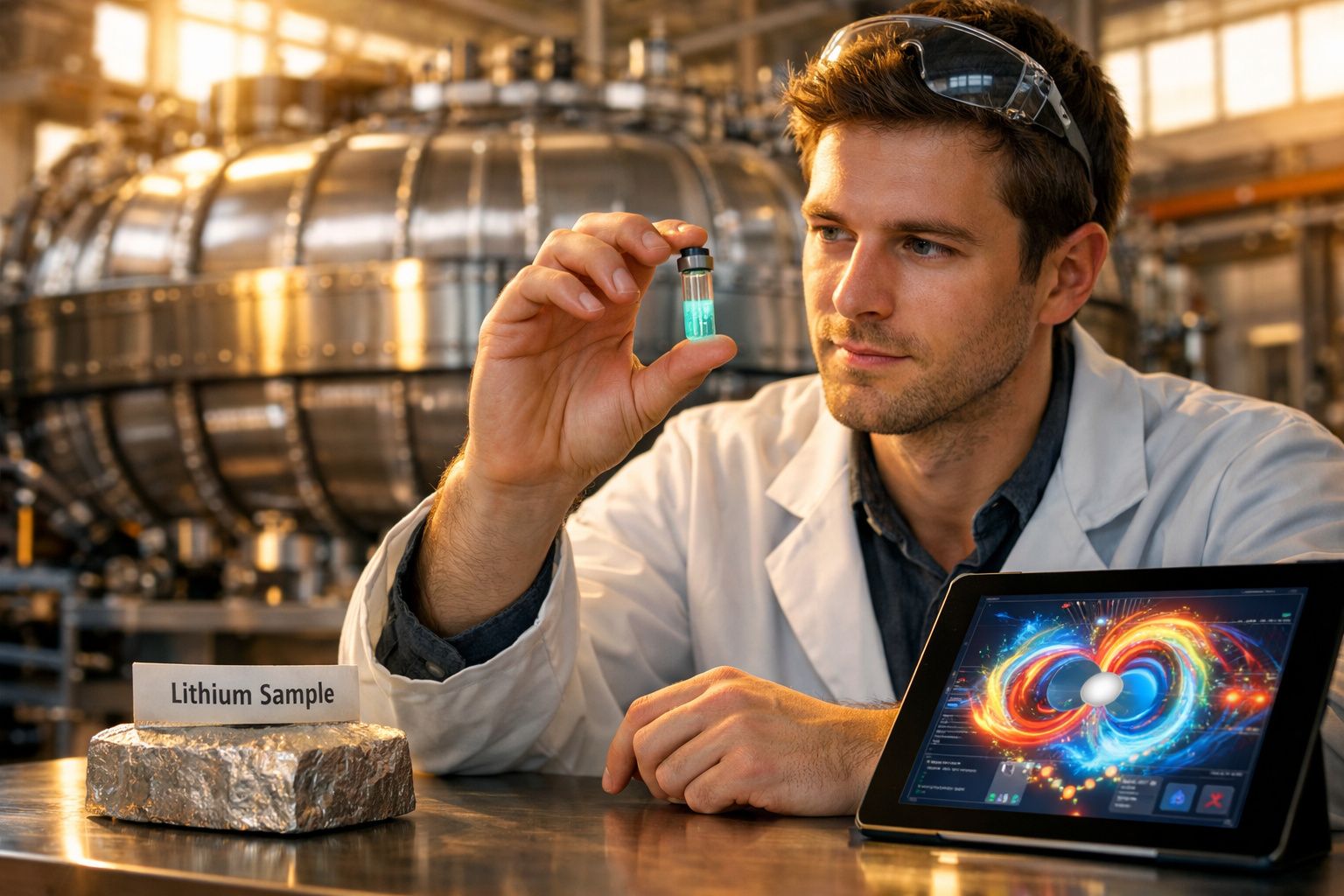
Why tritium could make or break fusion energy
Na corrida para transformar a fusão nuclear em eletricidade comercial, há um detalhe pouco vistoso que pode deitar tudo a perder: o trítio. Enquanto os holofotes se focam em ímanes gigantes e plasmas a milhões de graus, este isótopo raro continua a ser o “gargalo” que ameaça travar o salto da fusão do laboratório para a rede.
É por isso que está a gerar atenção a ideia de uma empresa britânica: um conceito de reator que, em vez de depender de um combustível escasso, conseguiria produzir mais trítio do que consome - mudando o problema de falta para potencial excedente.
Most advanced fusion projects rely on the same reaction: deuterium–tritium, often shortened to D–T. Deuterium is easy to source from seawater. Tritium is not.
Today, the global civil inventory of tritium is thought to hover around just 20 kilograms. That is barely enough to support a handful of demonstration reactors, never mind a future fleet of commercial plants.
Tritium brings a second headache: it decays. Its half‑life is about 12 years, meaning any stockpile literally shrinks on its own. Without a reliable way to regenerate it, any D–T fusion industry would stall.
Tritium is both the fuel of choice for early fusion reactors and the resource that could stop the entire sector scaling.
This is why tritium breeding-the ability to make more tritium inside the reactor than it consumes-has become one of the defining engineering challenges of fusion.
The FLARE concept: a fusion plant that mints its own fuel
Oxford-based First Light Fusion argues it has a credible answer. Its proposed power plant, known as FLARE, is designed not just to run on tritium but to manufacture a large surplus every year.
The key benchmark here is the Tritium Breeding Ratio (TBR). A TBR of 1 means a plant creates exactly as much tritium as it burns. Below that threshold, the fuel supply runs down over time. Above it, the facility becomes a net producer.
According to First Light Fusion and an independent analysis by UK firm Nuclear Technologies, the FLARE design reaches a TBR of 1.8. In practical terms, that means that for each unit of tritium consumed in fusion reactions, about 1.8 units are produced elsewhere in the system.
A TBR of 1.8 would turn a fusion plant from a tritium consumer into a regional fuel supplier for other reactors.
If that performance holds in real hardware, a single FLARE unit could support not only its own operation but also seed future reactors with the tritium they need for start‑up.
How FLARE tries to beat the tritium crunch
From magnetic bottles to high‑gain inertial fusion
Most people associate fusion with huge doughnut-shaped machines called tokamaks, such as the ITER project in southern France. These rely on powerful magnets to hold a searing plasma in place for long periods.
FLARE takes a different path. It is based on inertial fusion at high gain. Instead of confining plasma with magnets, this approach compresses a small target containing fusion fuel over a tiny fraction of a second, triggering fusion in rapid pulses.
Each shot releases a burst of energetic neutrons. Rather than letting those neutrons slam uselessly into the reactor walls, FLARE surrounds the reaction chamber with a carefully engineered “lithium blanket”.
The lithium blanket that turns neutrons into fuel
Natural lithium plays a central role. When high‑energy neutrons from the fusion reactions hit lithium atoms, nuclear interactions can generate fresh tritium.
The challenge is to capture as many neutrons as possible while still extracting useful heat and keeping the plant efficient. Engineers can adjust the thickness, composition and geometry of this lithium-rich region to tune performance.
First Light Fusion and Nuclear Technologies both modelled this system and arrived at similar TBR values around 1.8 for the current FLARE design. That figure depends heavily on assumptions about lithium composition, structural materials and neutron leakage, but the convergence of two independent studies has turned heads across the sector.
- Fusion target at the centre produces energetic neutrons.
- Neutrons stream into lithium-containing structures.
- Lithium converts part of that neutron energy into tritium atoms.
- Coolant extracts heat to run a power turbine.
- Newly formed tritium is collected, purified and fed back as fuel.
Economic stakes: tritium as a revenue line, not a liability
From scarce isotope to export product
The potential economics are striking. At a proposed electrical output of about 333 megawatts, First Light Fusion says a single FLARE unit could produce an annual tritium surplus of roughly 25 kilograms, once its own fuel needs are covered.
For context, that exceeds current global civil stocks. In other words, one mid‑scale plant, if it worked as advertised, could more than double present supplies every year.
Prices for tritium are highly uncertain and often confidential, but industry estimates typically range from 30,000 to 120,000 US dollars per gram. At those levels, the extra tritium from FLARE would represent a huge notional revenue stream.
At today’s quoted prices, the sale of surplus tritium from a single FLARE-like plant could in theory pay for the reactor itself.
Of course, an abundant new source would inevitably push prices down over time. A cheaper, plentiful supply might actually be welcome, since governments and private firms would no longer be constrained by a fuel bottleneck when planning fusion projects.
Strategically, any country able to field breeder-style fusion plants would gain a new form of energy security and, potentially, an export asset comparable to natural gas today.
Artificial intelligence steps into the fusion design loop
The FLARE announcement did not stand alone. First Light Fusion has also signed a memorandum of understanding with UK start‑up Locai Labs to apply artificial intelligence to its inertial fusion research.
The idea is to accelerate complex simulations at extreme pressures and temperatures, and to help optimise both software codes and reactor configurations. Running thousands of scenarios with high‑fidelity physics is expensive; AI models can learn patterns from existing runs and steer new calculations to where they matter most.
These tools will operate on secure, isolated high‑performance computing infrastructure in Oxford. That is a signal that fusion data, from target designs to neutron yields, is now seen as a strategic asset in its own right.
Other routes to a stable tritium supply
How major fusion players are hedging the fuel risk
First Light Fusion is not alone in worrying about tritium. Across the globe, both public programmes and start‑ups are testing parallel approaches to secure the fuel cycle.
| Actor / approach | Technical idea | Main goal | Status |
| ITER | Lithium-based breeding blankets (solid, liquid, ceramic with lithium‑6) | Measure and optimise tritium breeding in a large tokamak | Experimental tests planned |
| Commonwealth Fusion Systems | Compact breeding modules close to the plasma | Boost neutron capture and reduce losses | Advanced development |
| Tokamak Energy | High‑temperature magnets with integrated lithium modules | Raise TBR in a compact spherical device | Prototype work under way |
| Helion Energy | Pulsed architecture with tight fuel management | Cut reliance on external tritium supply | Pre‑industrial development |
| Lithium–lead alloys | Circulating liquid metals for both cooling and breeding | Combine heat extraction with tritium production | Advanced engineering studies |
| Lithium‑6 enrichment | Use isotope with higher reaction probability | Boost TBR for a given blanket design | Materials and process R&D |
| Hybrid fission–fusion systems | Special breeding zones in fission‑driven neutron fields | Industrial‑scale tritium generation | Conceptual and early design work |
| Advanced recycling | Recover tritium that did not undergo fusion | Reduce losses along the fuel cycle | Process development |
| D–D and D–He‑3 reactions | Alternative fuels using little or no tritium | Lower dependence on scarce isotope | Fundamental research stage |
This patchwork of approaches reflects a simple reality: no one is betting that a single technology will solve the tritium issue for every fusion concept. Tokamaks, stellarators, inertial fusion and novel machines such as field‑reversed configurations each interact with neutrons and materials in different ways.
What “TBR 1.8” really means in practice
The Tritium Breeding Ratio can sound abstract, but it translates into concrete operational questions: how long a plant takes to fill its own fuel inventory, whether it can start a sister reactor on the same site, and how often it needs to tap external supplies.
With a TBR of 1.8, FLARE is designed to reach fuel self‑sufficiency within about a week of operation, based on the company’s modelling. After that ramp‑up period, every additional gram of tritium it produces becomes potential export material or a buffer against outages.
A TBR that high also offers some headroom. If materials degrade faster than expected or neutron absorption is lower in real plants than in simulations, a built‑in margin could keep the system on the right side of the breakeven line.
At the same time, chasing very high TBR values can complicate engineering. Thicker breeder blankets may make maintenance harder. Exotic materials might be difficult to manufacture at scale. Balancing tritium yield with cost and reliability is likely to remain a central trade‑off for fusion designers through the 2030s.
Risks, open questions and what comes next
Enthusiasm around FLARE rests mostly on simulations and early‑stage studies. Turning that into steel, concrete and working hardware is a multi‑billion‑pound undertaking.
Several uncertainties stand out. Neutron damage to structural components remains poorly understood at the fluences relevant for long‑lived fusion plants. Handling and storing kilograms of tritium safely requires robust regulatory frameworks and specialised infrastructure. Shifts in lithium supply chains could also affect breeder designs that lean on enriched lithium‑6.
There is also a geopolitical angle. If only a handful of countries master tritium‑rich fusion first, others could face a new form of dependence, this time not on oil or gas but on a radioactive isotope needed to light their reactors.
For readers trying to make sense of the jargon, two terms matter. Tritium is a radioactive form of hydrogen with one proton and two neutrons, used because it fuses with deuterium at comparatively low temperatures. The Tritium Breeding Ratio is the measure of how effectively a plant uses fusion neutrons to generate more of that fuel inside its own shielding and cooling structures.
If the UK’s FLARE concept moves beyond paper and achieves even part of its promised TBR, the long‑standing “tritium problem” of fusion could shift from a looming shortage to a question of cost, design and international cooperation. The broader race will then be not only to spark fusion reactions, but to manage a complete fuel ecosystem that can scale to a global power network.





Comentários
Ainda não há comentários. Seja o primeiro!
Deixar um comentário